
Staff often need money before they spend it: a field trip, a site visit, a float for a busy season. The company pays out a cash advance, and the employee spends it on the company’s behalf.
Until the employee accounts for it, that money is still the company’s. Retiring the advance is how it’s accounted for.
What retiring an advance means
To retire an advance is to account for every naira of it. The employee shows what the money was spent on, with receipts, and the company closes the balance.
Some teams say “settle”, “liquidate” or “reconcile” an advance. The idea is the same.
Until it’s retired, an advance sits in the accounts as money the employee owes the company. The spending it paid for isn’t in the accounts as an expense yet.
The three ways an advance is accounted for
An advance is retired through one or more of these:
- Expenses. The employee records what they spent, with receipts. Once the expenses are approved, they’re set against the advance.
- Cash handed back. Money the employee didn’t spend comes back to the company, and Finance records it.
- Money still owed. If part of the advance can’t be accounted for, the employee owes it to the company. Your policy says how it’s recovered.
When the approved expenses, the cash handed back and any money recovered add up to the amount paid out, the advance is retired.
An example
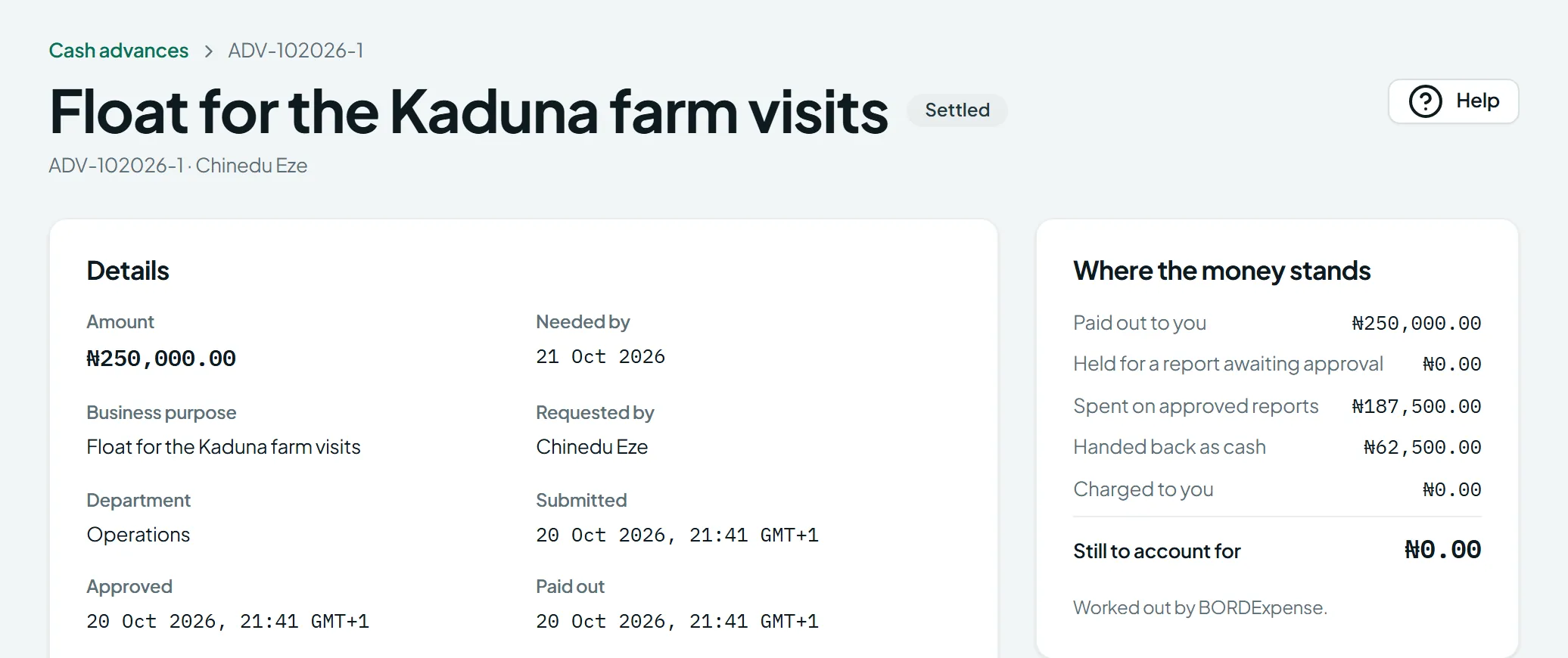
An employee takes ₦250,000.00 for a week of farm visits. They spend ₦187,500.00 on fuel, lodging, meals and taxis, and keep the receipts. They hand back the ₦62,500.00 they didn’t spend.
Their approver approves the expense report, and the ₦187,500.00 is set against the advance. Finance records the ₦62,500.00 handed back. Nothing is left to account for, so the advance is retired.
Why it matters to the finance director
- An open advance is money the company is owed. The longer it stays open, the harder it is to recover.
- Expenses belong in the period they were spent. An advance that isn’t retired keeps spending out of the accounts.
- One trail is easier to check. The advance, the expenses set against it and the cash handed back should point to each other, with the receipts attached.
- Clear rules are fairer to staff. Employees know what to hand in, and by when.
What to check before you close an advance
- The amount paid out matches the approved request.
- Every expense set against it is approved, and has its receipt.
- Any cash handed back is recorded, with your receipt reference.
- Anything still owed is agreed with the employee, and recorded.
- The accounting entries for the advance, the expenses and the cash are in your accounts.
Set a date by which each advance must be accounted for, and follow up when it passes.
How BORDExpense handles it
In BORDExpense, an employee asks for a cash advance, and an approver approves it. Finance records the pay-out.
The employee then records their expenses with receipts, groups them into an expense report and sets them against the advance. Finance records any cash handed back, and any money still owed.
Each advance shows where the money stands: paid out, spent on approved reports, handed back as cash, and still to account for. Your organisation can set a date by which each advance must be accounted for.
Finance reviews the accounting entries for the advance, the expenses and the cash, then posts them by hand or downloads a CSV for your accounting system. On the Premium plan, they go straight into Sage X3, with no re-keying.
To see an advance go from request to retired, request a demo.