
Approval Limits for Expenses decide how much each person can approve before a claim moves up to someone else. Set them well, and every report lands with a person who can judge it. Set them badly, and the finance director signs a ₦12,000 taxi claim. Meanwhile a ₦1.4 million trip gets a quick nod from a line manager.
Most organisations of 20 to 500 staff never write these numbers down. Claims arrive by email, and advances sit in a spreadsheet. Authority drifts toward whoever is available. That works until an audit or a disputed claim asks who allowed the spend.
The method below starts with your own claims data. It ends with a tier table you can adopt in naira or any other currency.
What Approval Limits for Expenses Control
An approval limit is the largest report total an approver can sign off alone. A line manager with a ₦150,000 limit cannot approve a ₦180,000 report. It goes to someone whose limit covers it.
Limit-based approval is the routing rule built on those numbers. The report total decides which approver sees it. The employee does not pick the approver, and the approver does not pick the claim.
Approver signing authority is the formal right to approve spending up to a stated amount. The approval limit is the number. The signing authority is the written permission behind it, granted by senior management.
Three ideas get mixed up in most policies, so keep them apart:
- Approval steps say who reviews a claim and in what order.
- Spending rules say what one expense may cost, such as a receipt required above ₦20,000.
- Approval limits say how much each reviewer can approve alone.
Each one changes for different reasons. Kept separate, you can raise a limit without rewriting your spending rules. The BORDExpense features page shows all three on real screens.
Read Your Own Claims Before Setting Approval Limits for Expenses
Copying another company’s numbers is the quickest way to build limits that do not fit. A firm that mostly pays fuel and per diems needs different bands from one that buys training and equipment. Approval limits for expenses should describe how your own staff spend.
Start with six months of approved expense reports instead. Export the totals, sort them from smallest to largest, and count how many fall into each band.
The table below shows an illustrative profile for a company of about 120 staff. Your counts will differ. The reading method stays the same.
| Report total | Reports in six months | Share of all reports | Running share |
|---|---|---|---|
| Up to ₦50,000 | 410 | 51% | 51% |
| ₦50,001 to ₦150,000 | 260 | 33% | 84% |
| ₦150,001 to ₦500,000 | 98 | 12% | 96% |
| ₦500,001 to ₦2,000,000 | 30 | 4% | 100% |
| Above ₦2,000,000 | 2 | Under 1% | 100% |
Here is how to read it. A first limit of ₦150,000 covers 84% of reports, so most claims need a single decision. The next tier sees 12% of reports, about 16 a month. Reports above ₦500,000 number 32 in six months, roughly five a month.
Run the same count on your own data. The percentages travel across currencies better than the figures do. A Ghanaian or Kenyan finance team can reuse the method with cedis or shillings.
A Tiered Example of Approval Limits for Expenses in Naira
Here is one way to turn that profile into approval limits for expenses. A report goes to the lowest tier whose limit covers its total.
| Approver | Limit per expense report | Limit per cash advance | What this person checks |
|---|---|---|---|
| Line manager | Up to ₦150,000 | Up to ₦100,000 | The trip or purchase happened and was needed |
| Head of department | Up to ₦500,000 | Up to ₦250,000 | The cost fits the department budget |
| Finance director | Up to ₦2,000,000 | Up to ₦750,000 | The claim follows policy and the figures add up |
| Managing director | Above ₦2,000,000 | Above ₦750,000 | The spend makes sense for the whole company |
Each number comes from the profile above. The line manager’s ₦150,000 covers the first 84% of reports. The head of department’s ₦500,000 reaches the 96% mark. Above that, the finance director and managing director handle the few large claims.
The threshold for finance director approval in this table is ₦500,000. That is the top of the head of department’s limit.
Four sample claims show the routing:
- A client visit of ₦85,000 stays with the line manager.
- A site visit of ₦320,000 goes to the head of department.
- A training bill of ₦760,000 goes to the finance director.
- An equipment claim of ₦2.4 million goes to the managing director.
Count the report total, not single lines. A ₦400,000 report made of eight ₦50,000 lines still needs the head of department. Also look at the largest claims each week. Finance can then spot one trip split across several reports to stay under a limit.
Smaller organisations can drop the head of department row. The finance director’s threshold then falls to the line manager’s limit. In the sample, that sends about 22 reports a month to one person. That is why the middle tier earns its place.
How to Choose the Threshold for Finance Director Approval
The threshold for finance director approval is the amount above which that person must read the report. It is the most argued number in the whole matrix.
Set it too low, and the finance director becomes a bottleneck. Claims wait for days, and the signature turns into a reflex. Set it too high, and large spend never reaches finance leadership.
Use volume as your guide. Decide how many reports the finance director can read properly each month. Then pick the amount that sends about that many. In the sample, ₦500,000 sends roughly five.
Pick a figure people can remember. ₦500,000 is easy to recall, while ₦487,500 invites questions.
Add a category rule where amount alone misses the risk. Equipment purchases, for example, may need the finance director at any total. The policy questions differ from those on a travel claim.
Approval Limits for Expenses on Cash Advances Need Their Own Numbers
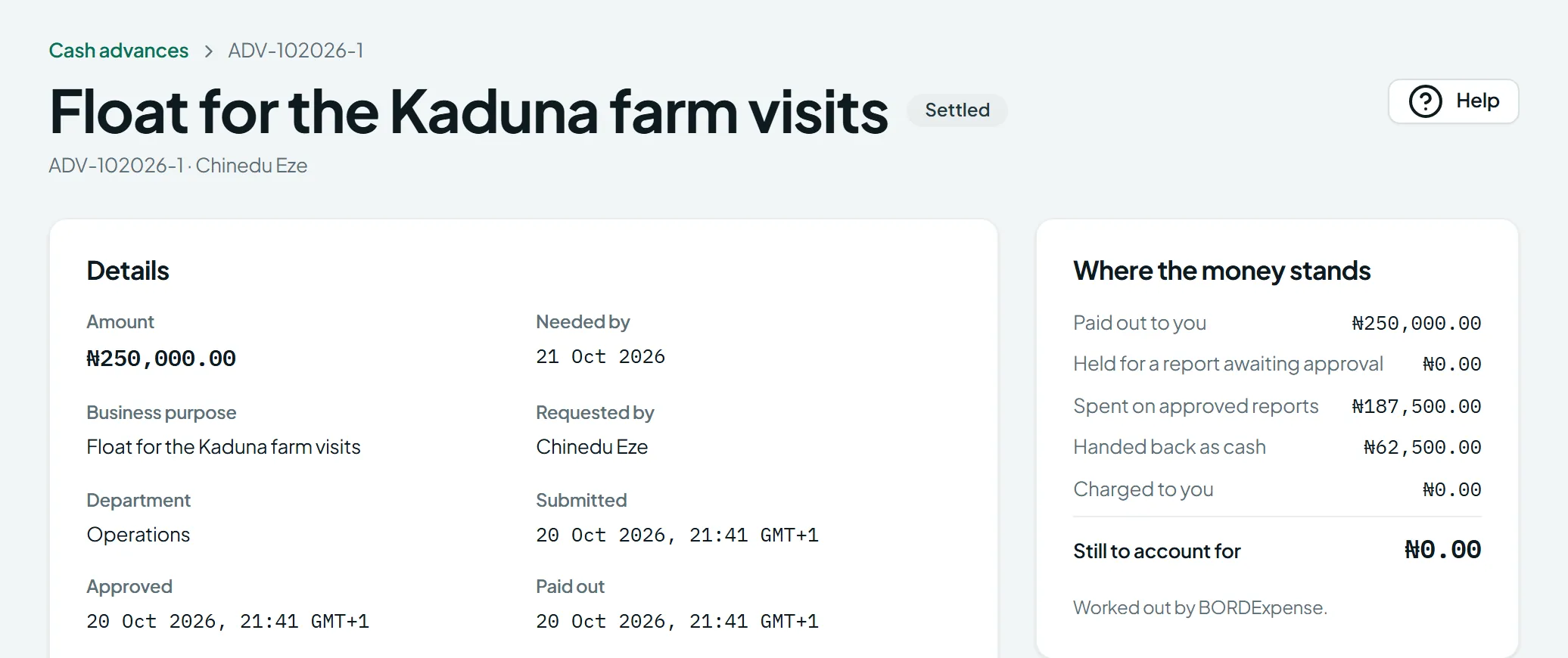
A cash advance is company money paid out before any receipt exists. The risk per naira is higher than on an expense report, where the spending has already happened.
So the approval limit for an advance should sit below the report limit for the same approver. The example table follows that rule at every tier. Three more points matter here.
- Retirement is a separate approval. The employee retires an advance on an expense report, and that report passes through its own limits. Our guide on how to retire a cash advance walks through each outcome in naira.
- Overspending becomes a normal claim. If the employee spends more than the advance, the extra follows the usual approval route and the usual limit.
- Late retirement is a Finance matter. Once the deadline passes, Finance can charge the balance to the employee. No new advance is paid until the old one is settled.
Write these limits into your cash advance policy so staff see the same numbers the approvers do. Finance also needs the right journals at pay-out and at retirement. The cash advance accounting entry guide sets them out.
Approver Signing Authority When People Are Away or Move
Approver signing authority only works if it follows the person and not the desk. Plan for leave, resignations and promotions before they happen.
Write the matrix on one page. List each approver by name, with their limit, the start date and who granted it. Reissue the page whenever someone changes role.
For absences, give each approver one delegate. The delegate’s limit should be equal to or lower than the approver’s. Set an end date, because open-ended delegation leaves old authority in place.
No one approves their own claim. Route a manager’s own reports to the next tier up. Every change to a limit should also leave a record of who changed it and when.
Plan one written exception route as well. An urgent trip may need approval above someone’s limit on a Friday evening. Name who can grant it and require a reason in writing. Then review every exception at month end.
BORDExpense lets an administrator hand an away approver’s work to someone else. It also keeps an audit trail that no one can edit.
Mistakes That Weaken Limit-Based Approval
Watch for five mistakes:
- Setting limits by job title alone. A senior title does not mean the person understands the spend. Tie each limit to what the approver can judge.
- Sending every report above a small amount to the finance director. The queue grows, and signatures become automatic.
- Leaving the numbers in a policy PDF. A limit nobody enforces is a suggestion, and auditors test what actually happened.
- Never reviewing the numbers. When prices rise, a fixed naira limit quietly tightens, and claims drift into higher bands.
- Having no written exception route. Staff then invent one, usually through a chat message to whoever will say yes.
Putting Approval Limits for Expenses to Work
Good approval limits for expenses come from your own claims, not from a borrowed template. Start with six months of reports and set the first limit where most of them are covered. Then choose a threshold for finance director approval that sends only what one person can read properly.
Three habits keep the system honest over time:
- Record approver signing authority for every approver on one dated page. It settles disputes quickly and gives auditors a clear record.
- Give cash advances lower limits than reports. Money paid before receipts exist carries more risk, so it deserves a tighter ceiling.
- Review the numbers every year. Growth and price changes push claims into higher bands, and old limits stop fitting.
A spreadsheet can hold the table, but it cannot stop a report reaching the wrong person. BORDExpense checks each approval limit when an employee submits. A report never lands with someone who cannot approve it.
Bring your draft table and request a demo. We will show you the same limits working on real screens.
Approval Limits for Expenses FAQ
What are approval limits for expenses?
Approval limits for expenses are the largest report totals each approver can sign off alone. A report above a limit goes to someone with higher authority. Finance usually sets them by role, from line manager up to managing director.
How do you set an approval limit for each approver?
Export six months of approved reports and sort them by total. Set the first limit where about eight in ten reports are covered. Add one tier for each step up in role. Test the draft against last quarter’s claims before you publish it.
What is a good threshold for finance director approval?
No single figure suits every company. A useful starting point is the amount that only 3% to 5% of your reports exceed. That keeps the finance director’s queue readable. Adjust it after one quarter of real claims.
What is limit-based approval?
Limit-based approval routes each report by its total. The total is compared with each approver’s limit. The report goes to the first approver whose limit covers it. This stops a claim landing with someone who cannot approve it.
What is approver signing authority?
Approver signing authority is the written permission to approve spending up to a stated amount. It names the person, the limit and the start date. Reissue it whenever that person changes role or leaves.
Should cash advances have the same approval limit as expense reports?
No. A cash advance is paid before receipts exist, so it carries more risk. Set the advance limit below the report limit for the same approver. The retirement report then follows its own limit.
How often should finance review approval limits?
Review them at least once a year. Also review them after any change in headcount or approver roles. Rising prices push more reports above fixed limits, so compare a fresh six-month profile with the last one.